
Weekly intelligence for Supply-Chain, Procurement & CEO desks
LEADERSHIP NUGGET
Procurement teams should not be designed around today’s workload.
They must be designed around the organisation’s forward-looking mandate.
Before discussing skills, roles, or development plans, procurement leadership requires clarity on one foundational question:
What is the organisation aiming to achieve in 2026 and beyond?
EXEC SNAPSHOT
This first deep-dive of the Procurement Roadmap 2026 series focuses on the starting point of effective procurement strategy: the team.
Core premise:
Procurement organisation design is not an HR exercise. It is a direct derivative of corporate goals.
Episode #106 examines:
how procurement leaders can source organisational objectives early in the year,
how these objectives translate into a procurement mandate,
how to assess the current team against that mandate,
and how to conduct structured alignment interviews that produce decision-relevant insight.

Raphael. (1510-1511). The School of Athens [Painting]. Vatican Museums, Vatican. https://www.wikiart.org/en/raphael/school-of-athens-detail-from-right-hand-side-showing-diogenes-on-the-steps-and-euclid-1511
Performance does not emerge from uniformity, but from the deliberate alignment of different roles, capabilities, and perspectives around a shared direction.
WEEKLY NEWS UPDATE
Topic | What changed | Why it matters for Procurement & SCM | Source |
|---|---|---|---|
Red Sea / Suez routing | Maersk conducted an additional, security-dependent trans-Suez sailing (Maersk Denver, 11–12 Jan 2026). | Early signal for potential lead-time normalization on Asia–Europe lanes. Relevant for Q1 transport planning and safety-stock assumptions. | Maersk (2026); Reuters (2026) |
Ocean freight rates | Drewry World Container Index increased +16% w/w to USD 2,557 per 40ft (08 Jan 2026). | Indicates renewed short-term landed-cost volatility, affecting freight budgets and surcharge clauses. | Drewry (2026) |
Germany: industrial data | Industrial production +0.8% m/m and new orders +5.6% m/m (Nov 2025 data, published 8–9 Jan 2026). | Signals short-term stabilization in parts of the European supplier base, relevant for capacity and lead-time risk assessment. | Destatis (2026) |
United States: labour market | Nonfarm payrolls +50k, unemployment 4.4% (Dec 2025, released 9 Jan 2026). | Mixed demand outlook; relevant input for volume planning, supplier utilization assumptions and negotiation timing. | U.S. BLS (2026) |
DEEP DIVE
1) Organisational goals first, procurement assumptions later
Procurement cannot define its future role in isolation.
Step 1 is to reconstruct the organisation’s strategic direction for 2026.
In January, the annual report of the prior business year is often not yet published. Procurement leadership therefore typically relies on a structured combination of sources.
Primary sources
management summaries or draft extracts of the Annual Report 2025,
executive strategy decks and board materials,
investor presentations and guidance updates (where applicable).
Operational “inside information” sources
last townhall or CEO update,
board and functional steering committee discussions,
approved transformation programmes (cost, footprint, portfolio, growth),
M&A or divestment signals,
capital allocation priorities.
The objective is not perfect information.
The objective is a directionally correct understanding of where the organisation is heading.
2) Translate corporate goals into a procurement mandate
Once organisational goals are understood, procurement leadership translates them into functional expectations.
Typical translation questions include:
Will procurement primarily support growth, stabilisation, or consolidation?
Is the dominant expectation speed, cost discipline, risk control, or a defined combination?
Will supplier landscapes expand (new markets) or contract (focus, standardisation)?
Is procurement expected to stabilise execution or actively shape strategic options?
This step defines the procurement roadmap before the team discussion begins.
3) Define the target procurement team profile
Only after the mandate is clear does team design become actionable.
Procurement leadership defines:
which roles are required to fulfil the mandate,
which capabilities must be available internally,
which profiles are critical and which are supportive.
This is not about job titles.
It is about functional contribution.
The outcome at this stage is a target profile, not an action plan.
4) Establish the current ACTUAL state
With the target profile defined, leadership assesses the current team reality.
Key questions:
Who is currently part of the procurement organisation?
What does each person actually contribute today?
Where do skills, mindset and mandate align — and where do they not?
This results in a target-vs-actual view that typically clusters into:
strong fit with the roadmap,
fit with development potential,
partial fit requiring role adjustment,
no fit within the future mandate.
This assessment must be analytical, not emotional.
5) Alignment interviews as a leadership responsibility
At the beginning of the year, many organisations conduct alignment interviews.
In practice, the outcome depends less on intent and more on preparation.
When interviews lack structure, three risks repeatedly emerge:
conversations drift into contract or compensation discussions that cannot be resolved,
expectations are raised without mandate or budget,
leadership credibility erodes through inconsistency across interviews.
The result is rarely visible immediately.
It shows up later in extended follow-up conversations, escalations, disengagement, and avoidable internal friction. In critical cases, poorly handled alignment interviews do not only consume time and budget; they put leadership positions at risk.
Well-run alignment interviews follow a small number of principles:
clarity on the procurement roadmap before individual discussion begins,
disciplined listening without promises or predefined outcomes,
structured documentation for analysis after the full interview cycle.
Typical questions address contribution, sustainability and perspective:
What do you need to perform sustainably, personally and professionally?
Where do you see your contribution by the end of 2026?
Where do you see yourself in two years?
The decisive factor is not the question itself, but the structure in which it is asked.
Most leaders have experienced interviews that went wrong due to missing preparation or unclear framing. Fixing the consequences later is expensive: measured in time, attention and organisational trust.
That is why we created The Alignment Interview Method™.
For USD 24.95, the guide provides a structured, research-backed framework to conduct alignment interviews without triggering negotiations, misaligned expectations or unnecessary escalation - so you stay in control of the conversation, the process and the outcome.
Compared to the cost of even one failed interview cycle, the decision is straightforward.
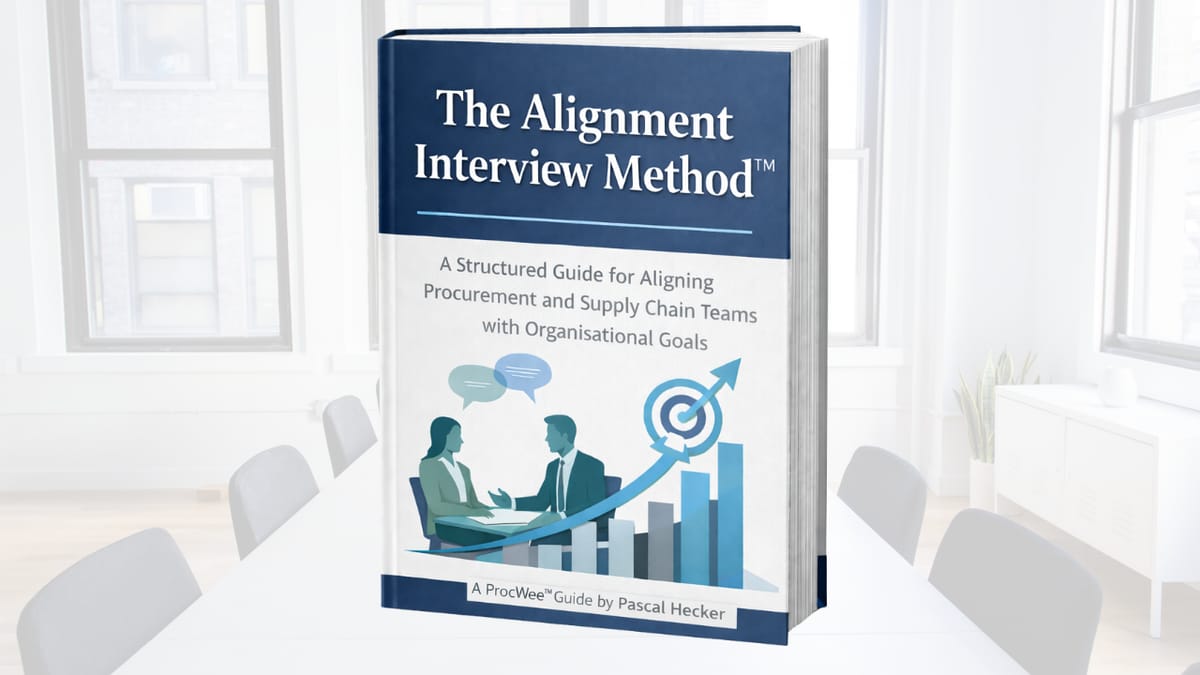
The Alignment Interview Method™
A structured leadership guide for aligning procurement teams with organisational direction (plus bonus interview checklist)
6) Development potential - and structural limits
Following the interviews, leadership evaluates:
who can realistically be developed into future-critical roles,
which gaps can be closed through development,
where expectations between organisation and individual diverge fundamentally.
Not every gap can be closed.
Not every role can be accommodated in the future organisation.
This is a structural outcome of mandate alignment.
7) Output of Step 1: The Team
The outcome of Step 1 is not reorganisation.
It is a leadership baseline that enables controlled execution throughout the year:
a clear and realistic view of the current ACTUAL state,
transparency on viable development paths within existing constraints,
early identification of structural mismatches,
and a defensible reference point for all subsequent roadmap decisions.
This clarity is what prevents alignment interviews from turning into negotiations, escalations or time-intensive follow-up discussions later in the year.
If you want to implement Step 1 consistently and protect yourself from avoidable leadership risk, a structured approach helps ensure this baseline is built consistently.
WHAT COMES NEXT - PROCUREMENT ROADMAP 2026
Episode #107: Target Setting & Organisational Alignment
Episode #108: Savings & Value Contribution
Episode #109: Supplier Portfolio & Lifecycle Positioning
Episode #110: Competition & Optionality
Episode #111: From Portfolio Decisions to Execution
Episode #112: Procurement Responsibility
Episode #113: Internal Authority Matrix & Decision Speed
SPONSORED - Productivity & Execution Efficiency
Most professionals think faster than they type.
For roles in procurement, supply chain and leadership, the bottleneck is often not language quality, but time.
Wispr Flow is a text-to-speech app designed to work across multiple applications, allowing users to dictate instead of typing. The practical benefit: faster capture of thoughts, notes and drafts, with consistent language output and less friction in day-to-day execution.
Used selectively, this can be relevant for:
meeting notes and internal drafts,
structured thinking on the go,
reducing time spent on routine text input.
Explore Wispr Flow here:
Note: As with any productivity tool, you should independently review data handling, IP protection and compliance requirements. Testing on non-sensitive and/or private use cases may be an appropriate first step, depending on company internal policies.
Prefer an ad-free experience?
ProcWee™ Independent Edition
ProcWee™ remains free to read.
For readers who value independent, focused procurement analysis without advertising, we offer ProcWee™ Independent Edition.
What you get:
ad-free reading experience,
uninterrupted access to all issues,
direct support for independent editorial work.
USD 2 per month. No obligations. Cancel anytime.
ONE-LINE VERDICT
Procurement organisations underperform not because of weak individuals,
but because team structure and roles are misaligned with corporate direction.
SOURCES
A.P. Moller – Maersk. (2026, January 12). Additional trans-Suez sailing: Maersk Denver. Retrieved from https://www.maersk.com/news/articles/2026/01/12/additional-trans-suez-sailing
Reuters. (2026, January 12). Maersk navigates Red Sea route again as Gaza ceasefire holds. Retrieved from https://www.reuters.com/business/energy/maersk-navigates-red-sea-route-again-gaza-ceasefire-holds-2026-01-12/
Drewry. (2026, January 8). World Container Index assessed by Drewry. Retrieved from https://www.drewry.co.uk/supply-chain-advisors/supply-chain-expertise/world-container-index-assessed-by-drewry
German Federal Statistical Office (Destatis). (2026, January 9). Production in November 2025: +0.8% on the previous month (Press release No. 008). Retrieved from https://www.destatis.de/EN/Press/2026/01/PE26_008_421.html
German Federal Statistical Office (Destatis). (2026, January 8). New orders in manufacturing in November 2025: +5.6% on the previous month (Press release No. 006). Retrieved from https://www.destatis.de/EN/Press/2026/01/PE26_006_421.html
U.S. Bureau of Labor Statistics. (2026, January 9). The Employment Situation — December 2025. Retrieved from https://www.bls.gov/news.release/pdf/empsit.pdf
Thank you for reading,
Pascal Hecker
Editor-In-Chief, ProcWee™